
Top five most improved RTT position:
Countess of Chester’s 15-point RTT turnaround
At a glance:

The challenge
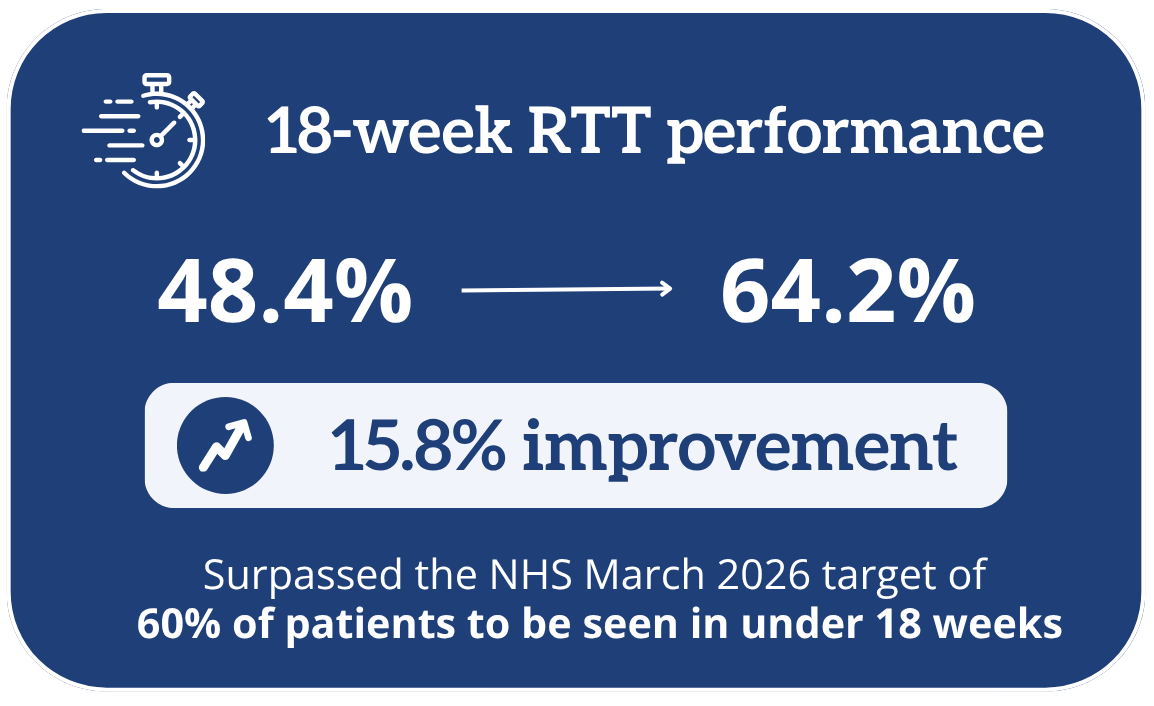
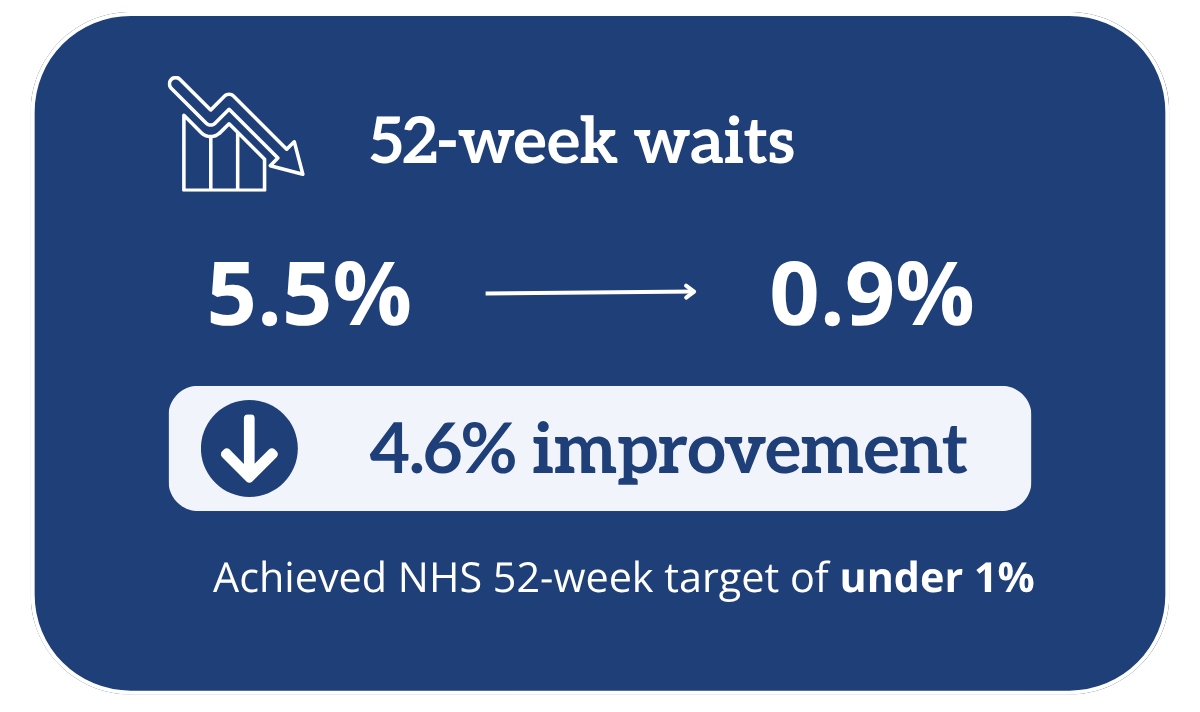
When NHS England reset RTT operational planning standards for 2025/26, Trusts faced a step-change in ambition. For The Countess of Chester Hospital NHS Foundation Trust, the numbers were stark: entering the year at just 48.4% 18-week compliance and 5.5% 52 week wait compliance, the Trust needed to improve by nearly 12 percentage points on 18-week performance and cut its long-wait position by more than half, just to meet the minimum standard.
‘We knew we had to do something fundamentally different. Business as usual wouldn’t have cut it.’
Shaun Brown, Deputy Chief Operating Officer
The Trust had been managing long waits through administrative validation and waiting list initiatives. But the new standards demanded more: either a significant expansion of face-to-face capacity or a clinical validation-led approach to genuinely reduce the list size. With income-backed funding secured through the Cheshire and Merseyside ICB, the Trust commissioned a suite of interventions with Consultant Connect’s referral triage and validation at the centre.
The approach
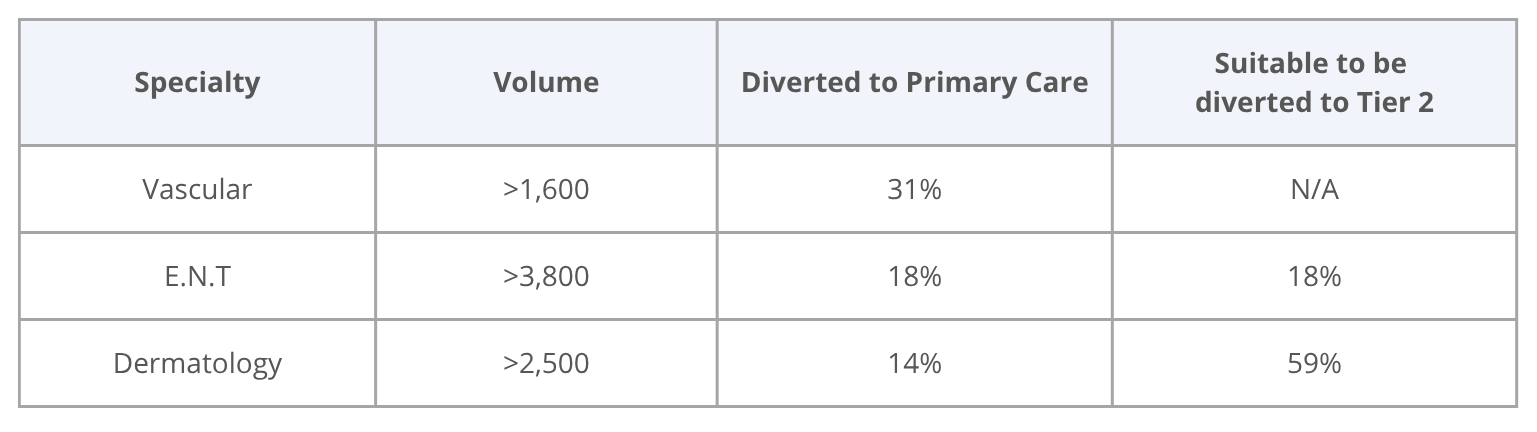
Consultant Connect delivered remote referral triage and validation using NHS consultants across Vascular, ENT, and Dermatology, three of the Trust’s highest-pressure specialties. Patients that did not require hospital care, were returned to primary care with a clear management plan, with others directed to the most appropriate hospital pathway or, where identified, to intermediate tier services.
‘It’s a really effective first-line intervention – to both reduce your waiting list size and triage pathways into community services. And longer term, it supports learning amongst your clinical teams.’ Shaun Brown, Deputy COO
Crucially, every diversion came with clinical reasoning and documentation, giving the Trust both an immediate reduction in list size and a body of data it could act on for future pathway changes, especially in light of ‘left shift’ discussions to stand up community services and neighbourhood model. The model sat alongside insourcing arrangements and outsourcing partnerships, but it was the triage that ensured that patients entered the correct pathway first time and only those needing acute care used up appointments: by rapidly organising the list, the Trust could direct its expanded clinical capacity precisely where it was needed most.
‘It’s a really effective first-line intervention – to both reduce your waiting list size and triage pathways into community services. And longer term, it supports learning amongst your clinical teams.’
– Shaun Brown, Deputy COO
For Dr Theresa Barnes, Medical Director, the results validated an ambition the Trust had held for some time and provided the data to act on it.
‘The sheer volume of activity that could appropriately be managed in intermediate-tier services was quite surprising to me. I always thought that was the way forward, but the evidence was really profound.’
Dr Theresa Barnes, Associate Medical Director
The triage data has become a direct catalyst for developing tier two services. For example, in ENT and Dermatology, the outputs from the work are now driving the design of intermediate care pathways in conjunction with the Cheshire and Mersey ICB and the Cheshire Model partnership.
Clinical teams also gained practical intelligence about referral quality. The triage process surfaced recurring themes in GP referrals. This data is now informing GP education and internal clinical learning.
There was initial resistance in some teams, particularly where there were concerns that patients would bounce straight back in and lose their place in the queue. But as the programme progressed, the evidence was persuasive: patients diverted from the queue received a detailed plan, the re-refer rate was low, and there was no additional administrative burden.
‘Once teams began to see that most referrals returned to primary care came with a clear plan, and that they were seeing fewer patients on their queues, it became particularly attractive.’
Dr Theresa Barnes, Associate Medical Director


The results
The Trust finished 2025/26 at 64.2% 18-week compliance, a 15.8 percentage point improvement, and reduced its 52-week position to 0.9%, meeting the national standard. It was recognised as one of the top five most improved RTT positions nationally in 2025/26, with one of the two largest improvements in 52-week performance in the country.
‘Consultant Connect was one of the most significant interventions. The proof is in the pudding – the discharge rate speaks for itself.’
Shaun Brown, Deputy COO
Operational lessons
Setting up the service required some initial effort to establish clinical access to the Trust’s EPR systems and letters. But Shaun Brown’s assessment was direct:
‘It was a lot easier than setting up an insource.’ –Shaun Brown, Deputy COO
Once the process was established, the model proved straightforward to scale across additional specialties, and the ability to switch it on and off as pressure points emerge was highlighted as a practical advantage for ongoing use.
Cost-effectiveness compared favourably with insourcing on a per-referral basis, and the Trust’s experience was influential in the subsequent decision to commission triage services on a wider regional basis.
‘Consultant Connect was one of the most significant interventions. The proof is in the pudding – the discharge rate speaks for itself.’
– Shaun Brown Deputy COO
Looking ahead
Both Shaun Brown and Dr Barnes point to referral triage as part of a longer-term shift in how the Trust manages its clinical front door. The ambition is for clinicians to be triaging at the point of referral, but in the interim, the ability to deploy external specialist capacity quickly and cost-effectively provides a proven mechanism for both managing demand and generating the data to build the case for system redesign.