
Behind every NHS client we work with is a team of people committed to making services work effectively – not just at implementation, but throughout the entire lifecycle of a project.
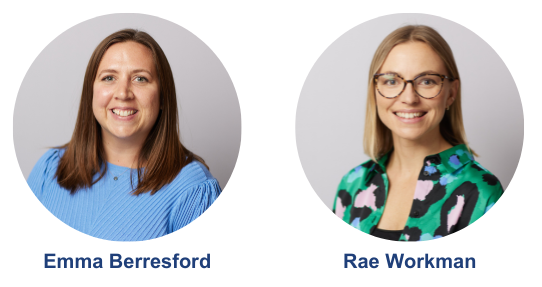
We spoke with our Group Customer Success Directors, Emma Berresford and Rae Workman, who lead teams delivering Advice & Guidance (A&G) and Referral Triage services across England, Scotland, and Wales. Working closely with NHS partners, they focus on supporting delivery, adapting to local needs, and ensuring services continue to deliver value over time.
What does your role entail?
‘We work alongside our Account Management Teams to support the implementation, delivery, and ongoing development of A&G and Referral Triage services across different NHS settings.
‘A key part of the role is building strong, collaborative relationships with our NHS partners – understanding local priorities, pressures, and pathways – so that services are shaped around how care is delivered in practice. That can include urgent care, elective pathways, community services, and cross-hospital working, as well as supporting Trusts with reviewing and prioritising waiting lists through Referral Triage.
‘It’s about making sure the service supports clinicians in a way that feels practical and sustainable.’
– Rae Workman.
Overseeing large-scale projects, what have been some key highlights for you?
‘One of the biggest highlights has been seeing how services grow and mature over time. That growth isn’t just in activity but also in the breadth of specialties, the range of users, and the ways services are applied across different clinical scenarios.
‘Since 2020, when the pan-Wales A&G project first went live, we’ve seen consistent increases in usage alongside really positive feedback from clinicians. What stands out most is the way services evolve in response to local challenges – whether that’s developing pathways, as Hywel Dda University Health Board did for the Wales General Ophthalmic Service 4 (WGOS 4), supporting follow-up care, such as the epilepsy pathways in Aneurin Bevan University Health Board, or exploring new areas, such as Patient Access for minor injuries.
‘Another example is the development of e-RS Connect, which came directly from conversations with NHS teams about the day-to-day frustrations in secondary care. Things like needing to download multiple attachments to review a referral can be time-consuming and inefficient. With e-RS Connect, clinicians can view attachments without downloading them and use filtering tools to prioritise urgent queries. They are subtle changes, but ones that are already improving efficiency for teams at University Hospitals Dorset and beyond.
‘Those moments where a challenge becomes a practical, working solution are always particularly rewarding.’
– Emma Berresford.
‘In Scotland, the digital dermatology project has been a real highlight. It involved close collaboration with NHS teams and integration with national systems, which meant working together and adapting along the way.
‘Hearing about patient impact brings it to life – for example, where access to specialist advice, supported by image sharing, has enabled treatment within 48 hours rather than a much longer wait of around 40 weeks. That’s ultimately what this work is about.
‘More recently, supporting Enhanced A&G in Greater Manchester has also stood out. Feedback from GPs about how rapid access to specialist input supports both their decision-making and patient care has been really encouraging.’
– Rae.
What are the biggest benefits of having a dedicated Consultant Connect Account Management Team for NHS areas?
‘A dedicated team helps reduce the operational burden on NHS staff. We recognise how busy services are, so having people who can coordinate activity, facilitate conversations, and support delivery from start to finish makes a real difference.
‘It’s not just about implementation – it’s ongoing support. That includes gathering feedback, sharing insights, and using data to demonstrate impact, as well as identifying opportunities to refine or expand services in line with local needs.’
– Emma.
‘Continuity and local understanding are key benefits. Account Managers build strong relationships with project teams and clinicians, which helps them understand the nuances of each area.
‘That allows services to flex when needed – for example, supporting capacity challenges in specific specialties. Where appropriate, Account Managers also liaise with NHS consultants on our National Consultant Network (NCN), who not only provide A&G but can also support with triaging referrals. This helps reduce pressure on elective pathways and supports patients in being seen in the right place, the first time.
‘Ongoing monitoring of metrics such as connection times and response rates allows any issues to be addressed quickly. That responsiveness comes from having strong, trusted relationships at a local level.’
– Rae.
What is required for a successful A&G project?
‘Having the right stakeholders involved is really important. That doesn’t necessarily mean large teams, but it does mean having key people who can guide conversations and connect us with the right clinical and operational leads.
‘Open, two-way dialogue is also essential – understanding the challenges services are facing while also looking at the wider system, so solutions are aligned with broader priorities.’
– Emma.
‘Successful projects are built on collaboration. When NHS teams and our teams work closely together, it creates a shared sense of ownership and momentum.
‘Raising awareness among clinicians is also key. The benefits of A&G can only be fully realised if clinicians know how and when to use it, so a mix of communication approaches is important – from local channels to direct engagement.
‘Using data to review performance, highlight successes, and identify areas for improvement also plays a big role in sustaining and developing services over time. We’re also working with NHS areas to develop Automated Outcomes, which supports teams in more easily demonstrating the impact of A&G at scale.’
– Rae.
How is this improving patient experience and relationships across care settings?
‘It supports a more joined-up approach across primary, secondary, and community care. For primary care clinicians, quick access to advice can help avoid delays for patients and reduce unnecessary outpatient appointments.
‘It’s about ensuring patients receive care in the right place, at the right time, while also improving how teams work together across the system.’
– Emma.
‘Timely access to specialist advice is central to this. When clinicians can connect quickly with the right person, it improves both decision-making and confidence.
‘We’ve seen many examples where this helps avoid unnecessary referrals or admissions, while ensuring patients who do need hospital care are identified sooner. It also strengthens relationships between teams, as communication becomes more direct and efficient.
‘Alongside this, we also facilitate regular knowledge sharing, such as quarterly Scotland round-table meetings, where Health Boards delivering Professional-to-Professional Advice* services can share learning and experiences.’
– Rae.
If an NHS director asked you why this model is worth investing in, what would your answer be?
‘The impact can be seen through both data and real-world experience. Alongside measurable outcomes, there are strong examples from clinicians about how access to timely advice supports them in practice.
‘We’re also seeing this at scale. In Wales, for example, the service is used by more than 7,000 clinicians across over 350 GP surgeries, 53 hospitals, the ambulance service, and all seven Health Boards, with access to more than 65 specialties. In one London project alone, more than 5,000 A&G activities are recorded each month. That level of adoption reflects the value it brings in day-to-day clinical practice.
Bringing together that scale, the measurable outcomes, and the lived experience of clinicians helps demonstrate the value across the system.’
– Emma.
‘There is clear evidence of system-wide benefit. 70% and 53% of calls to elective and urgent care specialties, respectively, avoid unnecessary hospital visits, thereby supporting both capacity and patient experience.
‘There are also wider benefits – reducing travel, minimising disruption for patients, and ensuring hospital resources are focused where they are most needed. It’s about supporting more efficient, patient-centred care across the NHS.’
– Rae.
* Advice & Guidance in Scotland
Related materials:
- Using Follow-Up calls to enhance efficiency and care for epilepsy patients at Aneurin Bevan
- How Consultant Connect is supporting Hywel Dda following the rollout of WGOS 4
- How e-RS Connect has reduced time taken for the dermatology team at UHL to respond to A&G by 25%
- How a single conversation helped resolve a patient’s long-standing symptoms in Manchester
- Press Release: Consultant Connect partners with NHS Scotland in nationwide teledermatology roll out
- 5 minutes with… NHS consultants on the NCN
- Faster decisions, fewer admissions – 11% rise in acute advice calls in 2024/25